“I believe that education which does not occur through forms of life or that are worth living for their own sake, is always a poor substitute for the genuine reality and tends to cramp and to deaden.”
-John Dewey
Consider the scenario:
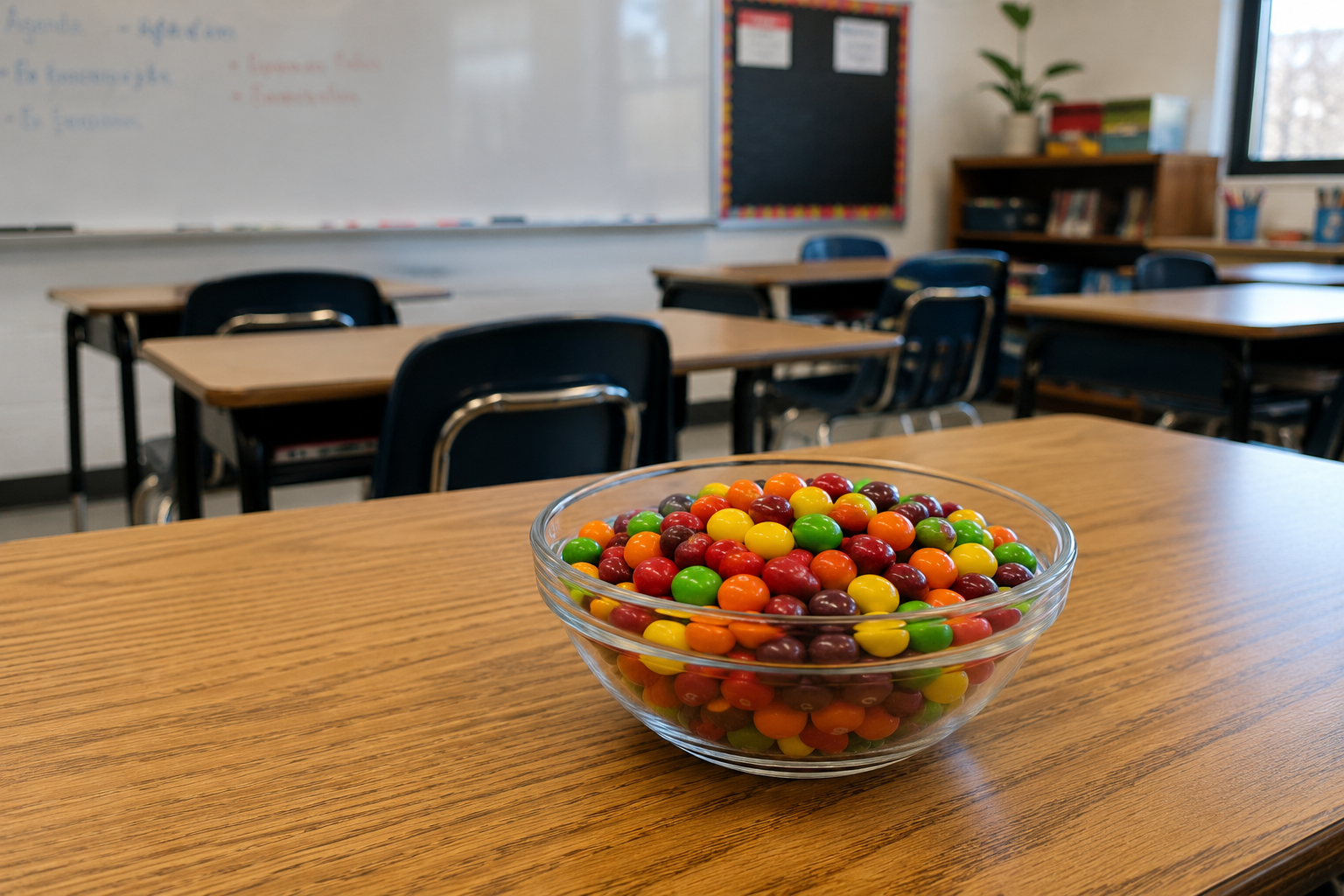
A salesperson for Skittles makes a case that every student should have a bowl of Skittles on their desk. He presents charts and graphs, “research,” and a slick slide deck that would wow even the most skeptical investor.
The low price of these Skittles excites parents who enjoy Skittles themselves, whose kids enjoy Skittles at home, and who trust they will be consumed responsibly.
When a few parents object that Skittles are not good for kids, the salesman responds: “Not to worry. Inside every bowl of Skittles will be five peas, and when kids reach into the bowl of Skittles, they will be instructed to grab the peas.”
“Then why not just have the peas?” a parent asks.
“Because they don’t like peas. The Skittles will trick them into thinking they like peas. Trust me, these Skittles will save the teacher so much time. Plus, kids need to be equipped to operate in a Skittles-heavy environment in college and in their careers. We wouldn’t want them to be behind everyone else, would we?”
The district decides to buy the Skittles, and even though you’re wary, you just read an MLive article about Ann Arbor being “The Most Educated City in America,” so you figure, I need to trust the experts here.
A few years down the line, a seismic world event takes place in which all kids must take Skittles home in order to prevent “learning loss.” That term will become ironic a little later, but you trust this is the right move.
A few years pass, and the Skittles come back into the classroom. But something has changed. The peas are rotting at the bottom of the bowl. The kids’ teeth are throbbing so badly they can’t pay attention. The only way to make the pain go away is to eat more Skittles. Teachers are beginning to spend as much of their time monitoring Skittles consumption as they are teaching.
You start to get suspicious. You ask for data to prove that Skittles make kids healthier, but you can’t find it. No one—not even the Skittles salesman, who has now retired on a pile of money—can show a single metric that supports the benefits of excessive Skittles consumption in school. You have a moment of reckoning. You realize this has all been a mistake. The Skittles need to go.
What do you do?
A few weeks ago, my son, who is an excellent student and an avid reader, broke down in tears during one of our bedtime chats: “Dad, I think I’m addicted to the computer at school. I can’t do this anymore. I just want to learn.” He and his friends had been bypassing the laughably porous filters and playing mindless games whenever they had “quiet time” or are supposed to be doing something “educational” on the computer.
I knew this was one of those pivotal moments when your kids needs you to say the right thing. I told him it wasn’t his fault. I explained the Skittles metaphor. He understood. He agreed that he was done with the computer for the rest of the year.
A few years ago, I invited U of M’s own Dr. Jenny Radesky, who literally wrote the book on screen time, to talk to our kids’ school’s parents about key considerations for kids and screens. We took her presentation to heart and have been very intentional about technology in our home. It’s not been easy to hold the line, but I believe it’s helped cultivate two avid readers with unusually long attention spans.
What we didn’t know was that the real battle would play out in the classroom.
I’ve been an educator for 20 years in another district and a parent in this one for 10. I’ve been a teacher, department chair, instructional coach, curriculum coordinator, online teacher, and honors program coordinator. I also taught Educational Technology in U of M’s master’s Program. I’ve always been an early adopter with tech. A colleague and I raised over $12,000 to buy class sets of Chromebooks before it was cool. My wife is the best teacher I know and pretty much all we talk about is education.
That’s my attempt to build some credibility.
What began as a good-faith effort to “meet kids where they are” was supercharged by COVID and, of course, tech companies like Google and Apple, whose business model is to hook kids early to ensure they’ll become lifelong customers.
Jonathan Haidt took on cell phones in The Anxious Generation but spared school laptops because, of course, they were for “educational” purposes. DreamBox and Lexia have become staples in the classroom, and yet I have not seen a study that shows any correlation between use of these apps and learning, except from the companies themselves.
It’s my belief that the underlying premise—one I bought into for several years—that we need to “meet them where they are” is fundamentally flawed. If kids are on screens all the time outside of school, perhaps it should be the one place where their exposure is limited.
If you’re anything like the average AAPS parent, you’re well-educated and well-resourced. You advocate for your child, you volunteer at school, you chaperone field trips, you donate to the PTO, Venmo the room parent to shower your child’s teacher with gifts, bid on items at the auction, attend board meetings to support your teachers working without a contract, volunteer to set up the ice cream social, raise money for fifth-grade camp, and coach the Lego League team. We’re a community of parents with means, knowledge, and energy to invest in their kids’ schooling.
Some of your kids have 504s and IEPs, and you’ve sat through hours of meetings with counselors and administrators to get them what they need. Some of you are paying for private tutors, or for private college counselors to get them into Harvard or U of M. Some of you have had your child opt out of state testing because you don’t see its value or don’t want your child to be labeled based on a number.
Hundreds of you showed up at a town hall in response to a threat made at one of our elementary schools. State Representative Debbie Dingell and the police chief showed up. You prompted the district to review its security procedures to ensure our students are safe. You put your money where your mouth is and passed a $1 billion bond a few years ago. You don’t just care about your kids; you care about all AAPS kids.
Without you, there would be no Ann Arbor Public Schools. No parents, no kids. No kids, no funding. No funding, no schools.
When something needs to be done, you step up.
Well, it’s one of those times.
We could get on the agenda at board meetings. We could send emails to the superintendent. We could organize a book club. We could join the technology committee to rewrite the tech plan, which hasn’t been updated since 2013.
Or we could just opt out.
You can opt out of state testing. You can opt out of your child’s photographs being posted publicly. You can opt out of sex education. You can opt out of special education services.
So, for the 2026–27 school year, let’s opt out of laptops. Take the Skittles off the desks and put them in the pantry where they belong. Bring them out only when absolutely necessary.
Caveat: I’m not suggesting all educational technology is bad, but to paraphrase Marshall McLuhan, when the medium becomes the message, we have a problem. A Chromebook cart for specific purposes—like word processing or research—is perfectly defensible. Similarly, showing a video here and there and watching it as a class, assuming it supplements what’s being taught, is fine pedagogy. There have also been incredible advancements for students with special needs.
But a laptop on every desk should not be the default.
This week, consider asking your child the following questions after school:
- How much time did you spend on the computer today?
- What did you do on the computer?
- What did you learn on the computer?
Then tell your child’s teacher that you would like your child off the computer for a week. Track their mood. Ask them about how much they’re learning. There may be a withdrawal period because they’ve been conditioned by recurring dopamine hits. But eventually, you’ll find that they are much more pleasant to be around—and so will their teacher. The most difficult part may be that they feel isolated from their classmates; as I told my son, that’s the price of being a leader.
Raising kids is hard. We’ve been seduced into believing that digital technology makes it easier. We slip an iPhone to our toddler while we enjoy a meal out. We click a button to swaddle our baby so we can stay in bed. In my case, my boys are addicted to watching any sport, any time of day; last week I caught them watching professional pillow fighting.
And, of course, teaching kids is hard. Schools need tools at their disposal to make sure kids are learning. But engagement is not learning. Often when we engage we are simply pacifying, and the computers make that incredibly easy.
Next year, no more Skittles for my kids. I hope you’ll join me.
Sincerely,
Rory Hughes
Ann Arbor Parent
Sources
Cooney Horvath, Jared. The Digital Delusion: How Technology is Misleading Us and What We Can Do About It. Simon & Schuster, 2025.
Dewey, John. My Pedagogic Creed. E. L. Kellogg & Co., 1897.
Haidt, Jonathan. The Anxious Generation: How the Great Rewiring of Childhood Is Causing an Epidemic of Mental Illness. Penguin Press, 2024.
McLuhan, Marshall. The Medium Is the Massage: An Inventory of Effects. Co-authored by Quentin Fiore, Random House, 1967.
Radesky, Jenny, et al. “Media and Young Minds.” Pediatrics, vol. 138, no. 5, 2016, p. e20162591. American Academy of Pediatrics, https://doi.org/10.1542/peds.2016-2591.


What do you think?