“The best portion of a good man’s life: his little, nameless, unremembered acts of kindness and love.”
— William Wordsworth
I used to despise Aldi. Maybe it was its cultish Millennial following, or perhaps it was the memory of my first experience there. I had offered to pay a friend, who was allegedly in recovery, to paint a room in my house while I was at work. I returned home to the stink of Aldi barbecued chicken, an empty bottle of Hennessy, and a poorly painted room. He had walked to the liquor store, walked to Aldi, come back and cooked the chicken, finished the bottle of Hennessy, then painted the room—in that exact order.
But as my family expanded, so did my grocery budget. After a multi-year boycott, I finally went back at the urging of the aforementioned Millennial friends. Once again, the “budget grocer” felt chaotic, poorly lit, and full of factory off-brand foods. As a self-proclaimed grocery snob, I wasn’t about to eat “Clancy’s” chips or “Burman’s” barbecue sauce, no matter the price. These sounded like the names of your great uncle from Kansas. And the pricing seemed absurdly low. Six brioche buns for $3.79? No way there was actually food in there. The meat aisle was downright repulsive—nothing organic or grass-fed, no packaging that even pretended to signal health.
But beyond Aldi’s products and the shopping experience, this quarter thing at the cart station befuddled me. It works like this: in order to get a cart, you insert a quarter into a little slot, which then dislodges the cart. You then return the cart by connecting it to the slot of another cart, and wa-la! your quarter pops out. These are the kinds of of processes that bring out the worst in me.
From a business standpoint, though, this is an incredible innovation. Carts are never lost—they’re neatly returned to their original home just outside the store. This allows for more parking spots, thus more shoppers. It’s a simple idea, whose genius doesn’t stop at the business side.
The magic, in fact, was unintended—this happens when a shopper is approaching the cart line and another shopper is returning from the parking lot with their cart. They lock eyes, and the cart seeker says to the cart holder, “Want a quarter?” In the ultimate win-win, the cart holder doesn’t have to fumble to connect the cart, and the cart seeker doesn’t have to fumble to disconnect the cart. In one 2-second transaction, two people receive some of life’s most important benefits:
Eye Contact
As you return from unloading your groceries, for once in your day, you are trying to make—rather than avoid—eye contact with a stranger. In this case, both parties are seeking eye contact because need each other to get what they want. Conversely, when I’m walking my dog, the person coming the other way—usually a Millennial or senior citizen—is either listening to a podcast, watching a video on their phone, or just staring downward because they can’t bear the thought of looking a stranger in the eye. There is no discernible benefit to them looking at me. In the Aldi parking lot, eye contact is required.
A Smile
With eye contact comes a smile—maybe the only time that person smiles all day and maybe the only time the other person is smiled at all day. Most other shopping experiences culminate on a touchscreen at a self-checkout, where the interaction is between human and computer code. There might be a cashier behind that code, but there is no benefit to you to smile at them. At Aldi, for just a moment, you acknowledge a human as a being, not as a means to your end.
A Thank You
There’s no “please” in this exchange, but there is always a “thank you,” sometimes two. And it’s genuine. How many times in a day do we say “thank you” and really mean it?
Human Touch
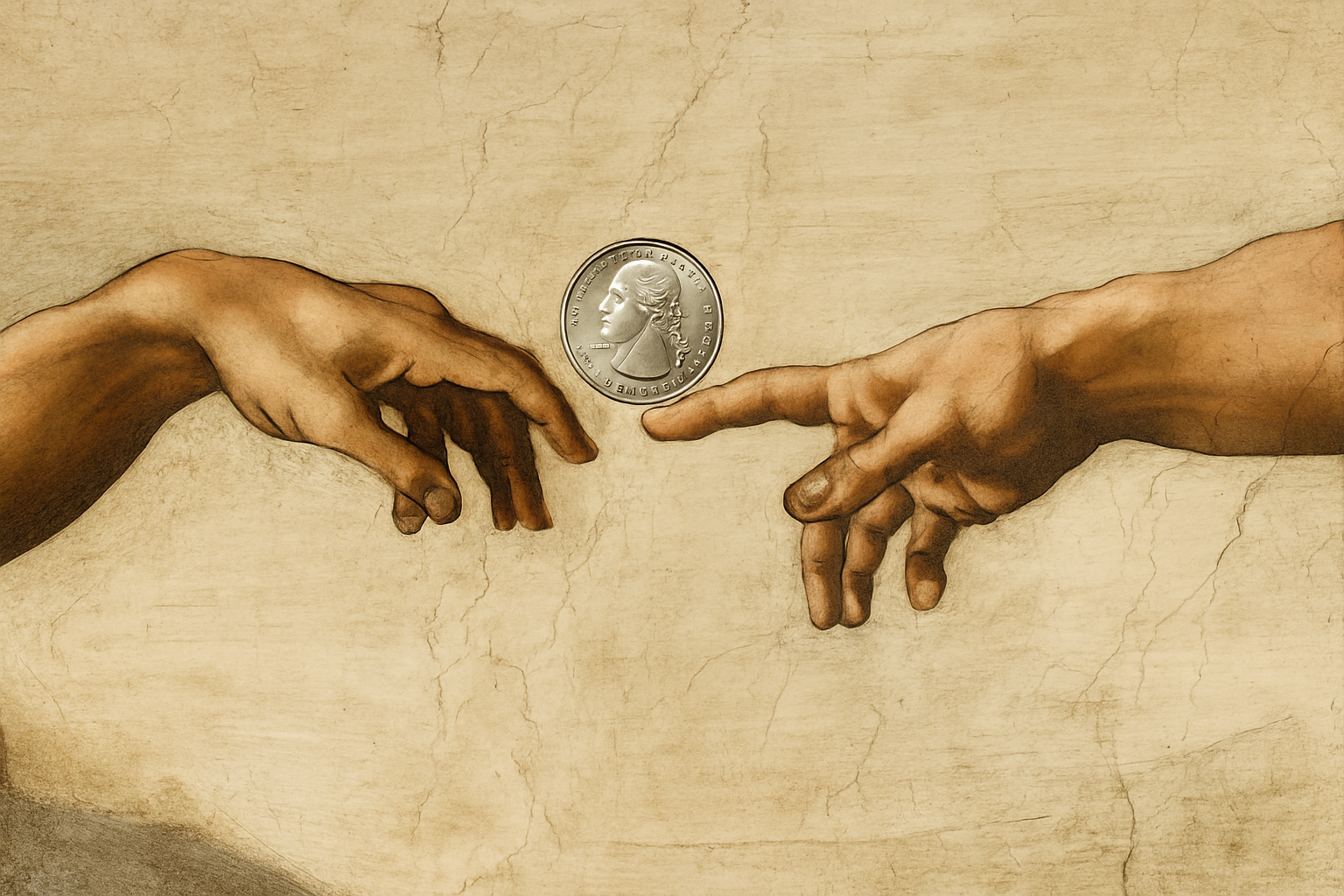
Another lost art: the original touch screen. When you hand over that quarter, for a brief moment, there’s a visceral connection with this person. There’s nothing intrusive or creepy about it. And like the smile, this might be the only time this person actually touches another person all day.
Aldi is still not my favorite store—although their corn chips, guacamole, salad dressing, and granola bars have become staples in my house. But they’ve figured something out about humanity and its primal need to relate to others.
Someday, loose change will be discontinued and carts will be robots, but until then, I’ll celebrate the fact that small moments of genuine connection can still happen in unlikely places.
But stay away from that Burman’s barbecue sauce.
Sources
Michelangelo. The Creation of Adam. c. 1512, Sistine Chapel ceiling, Vatican City. Adapted version created using ChatGPT image generation, 2025.
Thompson, Derek. “The Anti-Social Century.” The Atlantic, Feb. 2025, https://www.theatlantic.com/magazine/archive/2025/02/american-loneliness-personality-politics/681091/.


Leave a reply to Anonymous Cancel reply